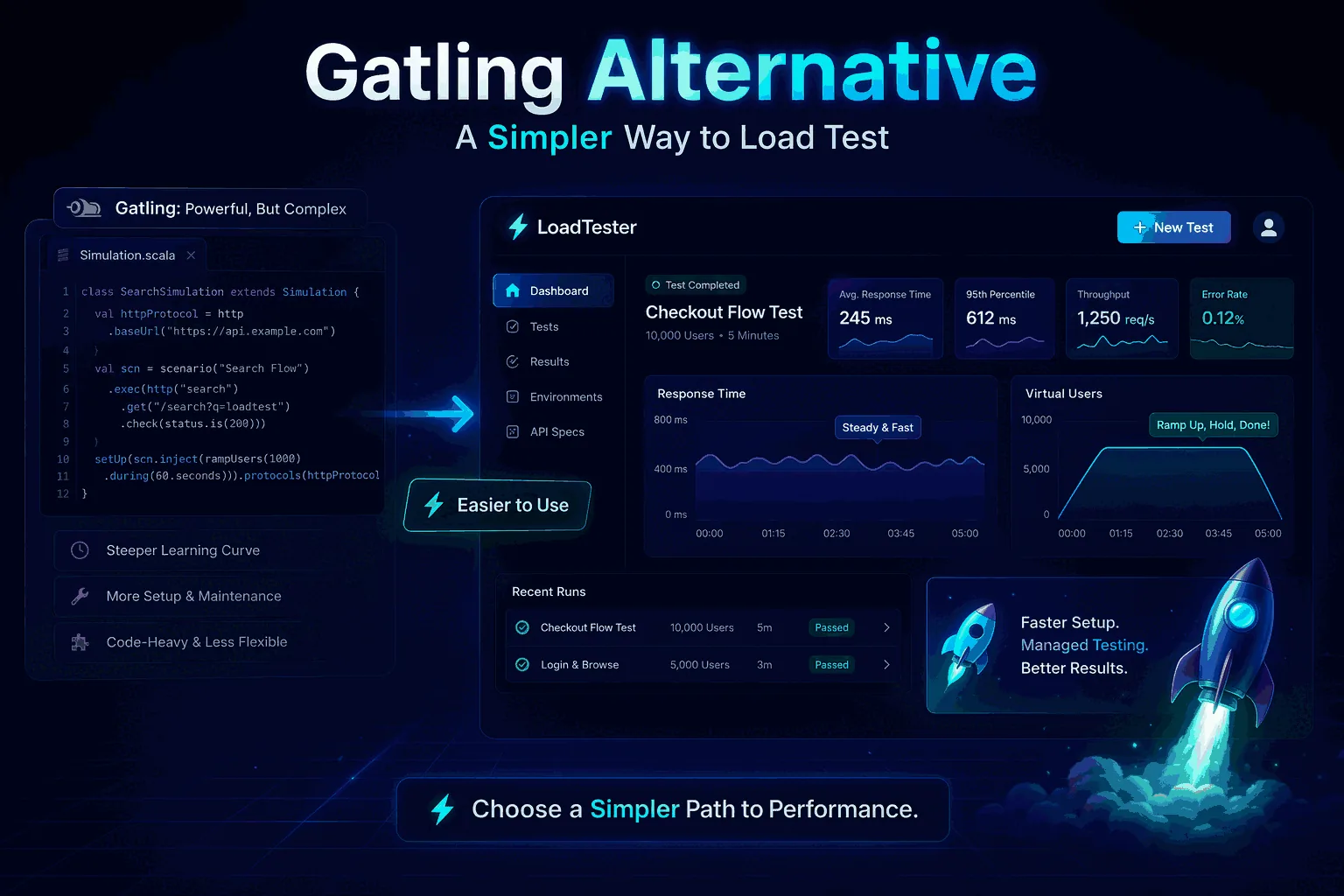
Gatling Alternative
Searching for a Gatling alternative usually means one of two things. Either you like the idea of powerful, realistic load testing, but the workflow feels heavier than you want, or you have already tried Gatling and discovered that your team needs something simpler to adopt, maintain, or run regularly. In both cases, the question is not whether Gatling is good. It is whether it is the right fit for your current stage, team shape, and delivery process.
Gatling has real strengths. It is respected for expressive scenario modeling, strong performance, and an engineering-oriented approach to load testing. For some organizations, that is exactly what they need. But many teams do not wake up saying, “We need a powerful framework.” They wake up saying, “We need repeatable load tests without turning performance work into its own internal platform.” That difference matters.
A good alternative should not only replicate request generation. It should reduce friction. That means faster onboarding, less scripting overhead, easier collaboration, better CI/CD integration, clearer reporting, and fewer operational surprises when the product changes. If you are new to the fundamentals, start with What Is Load Testing?. If you are already comparing tools, keep Gatling vs k6 vs JMeter and Best Load Testing Tools (2026) nearby as companion reads.
Why teams start looking for a Gatling alternative
Gatling’s promise is appealing: realistic scenarios, efficient execution, and a serious engineering model for performance testing. The issue is that “serious engineering model” can be read in two very different ways. Mature performance teams hear it as “powerful and scalable.” Smaller product teams often hear it as “another thing we now have to maintain.”
One common trigger is authoring complexity. A code-centric framework can be clean in experienced hands, but it also creates a dependency on people who understand the framework well. When only one or two engineers can update scenarios, load testing becomes specialized work rather than shared operational practice.
Another trigger is time to useful result. Teams do not only want to run a test. They want to answer a release question fast. Can the API handle the next rollout? Did a change increase tail latency? Did authentication become a bottleneck? If the path from idea to answer is long, the tool becomes something you use occasionally rather than routinely.
A third trigger is team accessibility. Product engineering, QA, and platform teams often need to discuss performance together. A framework that is elegant for specialists may still be hard for the broader team to understand. That can slow prioritization and create avoidable bottlenecks.
Finally there is total workflow cost. Even when the software itself is attractive, teams may realize they are paying in setup, scripting, load generator management, result interpretation, and onboarding. That is why “alternative” searches often come from healthy instincts. The team is not asking for less rigor. It is asking for a better trade-off.
What a strong Gatling alternative should give you
A serious alternative should improve at least four things.
First, it should reduce setup and maintenance overhead. That means less time building scaffolding before you get a trustworthy test. If every new environment, token flow, or scenario variant requires framework-heavy updates, the suite becomes expensive to maintain.
Second, it should support repeatability. Performance testing only becomes valuable when it is consistent enough to compare across runs, branches, environments, and releases. Tools that make versioning, thresholding, and result sharing easy tend to outperform more powerful but more specialized stacks in day-to-day engineering work.
Third, it should be friendly to CI/CD. The future of performance testing is not “once before launch.” It is layers: tiny smoke checks on pull requests, deeper tests on merge or nightly builds, and larger scheduled runs for critical paths. If the tool fits that layered model, adoption rises. Read Load Testing in CI/CD and Continuous Load Testing for the bigger workflow picture.
Fourth, it should help the team understand what the results mean. Load testing without clear metrics is just expensive noise. Good reporting should help you reason about throughput, errors, saturation points, and percentile latency. If your team does not already think in percentiles, read p95 vs p99 latency explained.
When Gatling is still the right choice
A balanced recommendation starts with honesty: sometimes Gatling is not the problem.
If you have a strong engineering team, already understand the framework well, need rich scenario expression, and treat performance testing as a first-class engineering practice, Gatling can be a very good choice. It is particularly attractive when realism and control matter more than broad team accessibility.
If your existing Gatling suite is already stable, well owned, and integrated into pipelines, switching for the sake of novelty may not help. The migration cost may exceed the workflow gain.
And if your load testing needs are unusually advanced, you may value framework power more than simplification.
That said, many searches for “Gatling alternative” come from teams that are not in that situation. They are not trying to replace a strong mature practice. They are trying to escape a workflow that feels harder than it needs to be.
Alternative 1: k6
k6 is one of the most common alternatives teams evaluate after Gatling because it preserves a code-first, engineering-friendly mindset while often feeling lighter and more modern operationally. The JavaScript authoring model is familiar to many teams, which reduces the learning curve. Tests can live in Git, run from the CLI, and slot into CI/CD pipelines without much ceremony.
Where k6 often wins is developer ergonomics. Many teams find it easier to review and maintain than more framework-heavy approaches. Scenario logic is readable, thresholds can be encoded alongside tests, and the overall experience fits contemporary engineering expectations.
Where k6 may still feel like work is the same place many code-first tools do: you are still writing and maintaining scripts. If your main goal is to reduce the team’s authoring burden radically, k6 may be better than Gatling without fundamentally changing the model. That is not bad. It just means the improvement may be moderate rather than transformative.
If your team is comfortable in code and wants an open, modern workflow, k6 is usually near the top of the shortlist. For more context, read LoadTester vs k6 and Gatling vs k6 vs JMeter.
Alternative 2: JMeter
JMeter is not newer than Gatling, but it still appears in many evaluations because it offers a GUI-based workflow that some teams find easier to start with. If your main pain with Gatling is that the authoring model feels too developer-centric, JMeter can look appealing because you can build test plans visually.
However, this is where many teams trade one form of friction for another. JMeter may reduce the barrier to entry for non-coders, but large test plans can become hard to maintain, hard to diff, and hard to explain. The suite can become visually complex and operationally heavy over time.
For that reason, JMeter is usually not the best answer if your goal is “I want a modern Gatling alternative.” It is more often the right answer if your organization already knows JMeter, prefers GUI workflows, and accepts the maintenance profile that comes with them.
If you are evaluating the broader trade-off, read LoadTester vs JMeter. The biggest lesson is that “easier to start” does not always mean “easier to sustain.”
Alternative 3: LoadTester
For many teams, the best Gatling alternative is not another framework. It is a simpler workflow.
LoadTester is designed for teams that want to run API and website load tests quickly without building a large scripting and infrastructure practice around the act of generating traffic. That makes it attractive when the bottleneck is not theory but execution. The main value is not that it can make requests. Many tools can do that. The value is that it reduces the gap between “we should test this” and “we have a result we can trust.”
Compared with Gatling, the advantage is lower operational weight. Teams can spend less time on authoring mechanics and more time on workload quality, thresholds, and release decisions. It is especially compelling for teams that want recurring tests, CI/CD checks, and cleaner collaboration without turning load testing into a specialized engineering niche.
This matters because most teams do not fail at performance testing because the engine is weak. They fail because the process is too heavy to run consistently. If that sounds familiar, LoadTester is a stronger alternative than simply hopping from one code framework to another.
Alternative 4: Locust
Locust is sometimes evaluated as an alternative because it is simple, scriptable, and popular with Python-friendly teams. If your organization already writes a lot of Python, the authoring model can feel approachable. For teams that like code but do not want a more specialized performance framework, Locust can be appealing.
The question is whether it solves the same problem you are trying to solve. If you want flexibility and are comfortable owning scripts, Locust can work well. If you are specifically looking for less operational burden, it may still leave you managing much of the same lifecycle work: scripts, environments, thresholds, reporting conventions, and process design.
It is a viable option, especially for Python-native teams, but it is not automatically a lighter path just because the language is familiar. For more on that angle, see Locust Alternative.
Open source alternative vs managed alternative
This is one of the most important distinctions in the entire evaluation.
An open source alternative changes the framework. A managed alternative changes the workflow.
If you switch from Gatling to k6 or Locust, you may improve script readability, team familiarity, or CI alignment. Those are meaningful gains. But you still own the broad shape of the practice: scripting, orchestration, result interpretation, storage decisions, and maintenance.
If you switch from Gatling to a managed platform, you are often trying to remove more of that ownership burden. The benefit is not just fewer lines of code. It is faster adoption, easier delegation, and more routine execution.
Neither path is inherently better. If you need maximum customization and have the engineering depth to support it, open source may remain the right choice. If your main goal is repeatable tests with minimal friction, managed platforms often provide more leverage.
Comparing Gatling alternatives by team type
For a developer-led startup, k6 is often a strong alternative because it aligns with code, Git, and automation. LoadTester can be even more attractive if the team wants speed and simplicity over scripting control.
For a QA-heavy team with mixed coding comfort, JMeter may look easier at first, but long-term maintainability should be evaluated carefully. A managed platform may reduce both coding and GUI sprawl.
For a Python-heavy engineering organization, Locust is a natural alternative to test because the language match lowers adoption resistance. Just be honest about how much of the workflow you still need to own.
For a small team without a dedicated performance specialist, the best alternative is usually the one with the lowest operational friction. That often points toward a managed solution rather than another framework.
For a mature platform or performance team, Gatling may still be worth keeping unless a different tool produces a clear operational advantage.
How to decide whether to switch away from Gatling
The wrong way to decide is by reading feature matrices until one logo feels better than another. The right way is to run a practical comparison based on your real workflow.
Pick one important scenario, such as login plus search plus checkout, or authentication plus two critical API endpoints. Then ask each tool to do the same job:
- Create the scenario
- Parameterize data
- Define thresholds
- Run it locally
- Run it in CI or a staging pipeline
- Share the results with the team
- Update the test after a small product change
This reveals more than any marketing page can. You will quickly see which tool makes the full cycle easier.
Also measure the human side. How many people on the team can understand the test after one review? How long does it take to onboard someone? How much custom explanation is required? Tools that look technically capable sometimes fail this practical test.
What beginners often get wrong about alternatives
The first mistake is treating “alternative” as a synonym for “cheaper” or “open source.” The real question is total cost of useful testing, not license price.
The second mistake is choosing a tool based only on how the first test feels. Long-term maintainability matters more than day-one excitement.
The third mistake is ignoring internal process. If you do not define realistic traffic models, thresholds, and ownership rules, changing tools will not fix your load testing practice.
The fourth mistake is failing to distinguish between APIs and websites. The best alternative for backend-heavy API testing is not always the same as the best option for website user flows. Read Website Load Testing vs API Load Testing if you are mixing those concerns today.
Practical questions to answer before you switch
Before replacing Gatling, make the decision concrete. Ask what problem you are really solving. Is the issue authoring speed, team adoption, reporting, CI/CD integration, infrastructure ownership, or all of the above? Many teams waste time comparing tools at the feature-list level without deciding which workflow pain matters most.
A useful shortlist usually answers five questions clearly:
- Can more than one engineer update and review scenarios confidently?
- Will the tool fit your existing release workflow instead of becoming a side project?
- Can results be shared in a way product, engineering, and operations all understand?
- Will the suite stay current as endpoints, payloads, and user journeys change?
- Does the operating model match your team size and available time?
If you can answer those questions with examples from your own environment, you will make a better switch decision than you will by comparing headline throughput claims alone. That is also the fastest way to avoid moving from one heavy workflow to another.
The best Gatling alternative for most teams
If your priority is a modern code-first open source workflow, k6 is usually the strongest direct alternative. It keeps the engineering spirit while reducing some of the framework heaviness.
If your priority is GUI access and familiarity for a wider QA audience, JMeter is still worth considering, though it is often a step sideways rather than forward in workflow modernization.
If your priority is simplicity, repeatability, and less operational burden, the better answer is often LoadTester. That is especially true for teams that care more about getting useful performance answers quickly than about owning every layer of scripting and infrastructure.
Final thoughts
Gatling is a strong tool, but not every strong tool is a strong fit. If your team is searching for a Gatling alternative, the deeper issue is probably not traffic generation. It is workflow friction.
The right alternative should make performance testing easier to start, easier to maintain, easier to automate, and easier to understand across the team. For developer-led teams, k6 is often the best open source alternative. For teams that want to reduce the overall burden of load testing, a managed platform like LoadTester is often the better move.
Choose the tool that makes good performance habits realistic every week, not the one that looks the most impressive in isolation.
FAQ
What is the best alternative to Gatling?
For many developer-led teams, k6 is the best open source alternative because it offers a modern, code-first workflow with strong CI/CD fit. For teams that want less operational burden and faster adoption, a managed platform such as LoadTester is often a better overall alternative.
Is k6 easier than Gatling?
For many teams, yes. k6 is usually easier to onboard because the JavaScript-based workflow feels familiar and the operational model is straightforward. But it still requires scripting and ownership of the test lifecycle.
Is JMeter a good alternative to Gatling?
It can be, especially for teams that prefer GUI-based authoring. However, JMeter often introduces its own maintenance challenges, so it is not always the best choice for teams seeking a more modern workflow.
Should I switch from Gatling to a managed tool?
You should consider it if your biggest pain points are setup time, scripting overhead, report sharing, and CI/CD adoption. Managed tools often remove more workflow friction than a framework-to-framework swap.
What if my team already knows Gatling?
If the suite is stable and the team is productive, staying with Gatling may be sensible. Switching makes the most sense when the current workflow is slowing adoption or preventing regular, repeatable load testing.
Migration checklist: moving away from Gatling without creating chaos
If you decide to move away from Gatling, do not treat the migration as a tool swap only. Treat it as a chance to improve the practice.
Start by identifying your most valuable scenarios. These are usually not the longest or most complex tests. They are the scenarios that answer important release questions. Examples include login under load, search plus filtering, checkout, webhook ingestion, or a small set of critical API endpoints. Move those first.
Next, define your performance thresholds clearly before migrating anything. If the existing suite only says “the test passed,” you are missing the benchmark you need for the new tool. Use thresholds around error rate, p95 latency, p99 latency, and throughput where relevant. This is where p95 vs p99 latency explained becomes operationally useful rather than theoretical.
Then simplify your scenarios. Migration is the perfect time to remove clever but low-value complexity. Many performance suites become harder than they need to be because they try to encode every possible branch in one place. A better pattern is to keep scenarios targeted, realistic, and easy to interpret.
Finally, plug the new tests into delivery. If the new tool does not end up in pull requests, merge checks, scheduled runs, or release gating, you have only changed syntax. You have not changed the workflow. That is why migration should always be paired with a plan for Load Testing in CI/CD.
Signs you have already outgrown Gatling
Not every team searching for an alternative has fully admitted the problem yet. Here are signs that your current Gatling workflow is no longer serving the team well.
One sign is that tests are rarely updated. If the application has changed several times but the performance suite still targets old paths or stale assumptions, the framework may be too costly to maintain.
Another sign is that results depend on one person. If the team cannot confidently interpret a report without the original author present, your workflow is too specialized.
A third sign is that tests are run only before big launches. That usually means the operational cost is too high for routine use. Mature performance practices are continuous, not ceremonial.
A fourth sign is that the team debates tool mechanics more than product behavior. If most conversations are about how to make the framework behave instead of what the metrics mean, the tool is consuming too much attention.
If several of these sound familiar, you probably do not need more convincing that an alternative is worth testing. You need a practical transition plan.
Signs your evaluation is focusing on the right things
A strong evaluation does not stop at feature parity. It should tell you whether the next tool will increase testing frequency, broaden team participation, and produce reports people can actually act on.
- You can explain the migration in terms of team speed and release quality, not just tool preference.
- You know which scenarios must move first and which can be retired.
- You have agreed on thresholds, percentiles, and ownership before the switch happens.
- You can describe how the new workflow will fit into CI/CD and scheduled testing.
If those answers are missing, keep evaluating. The best alternative is not just the one that can generate load. It is the one your team will actually use consistently.
Use LoadTester when your goal is frequent API and website tests, cleaner collaboration, and useful threshold-based decisions without adding infrastructure ownership.