
LoadTester vs Loader.io: side-by-side comparison
Quick verdict
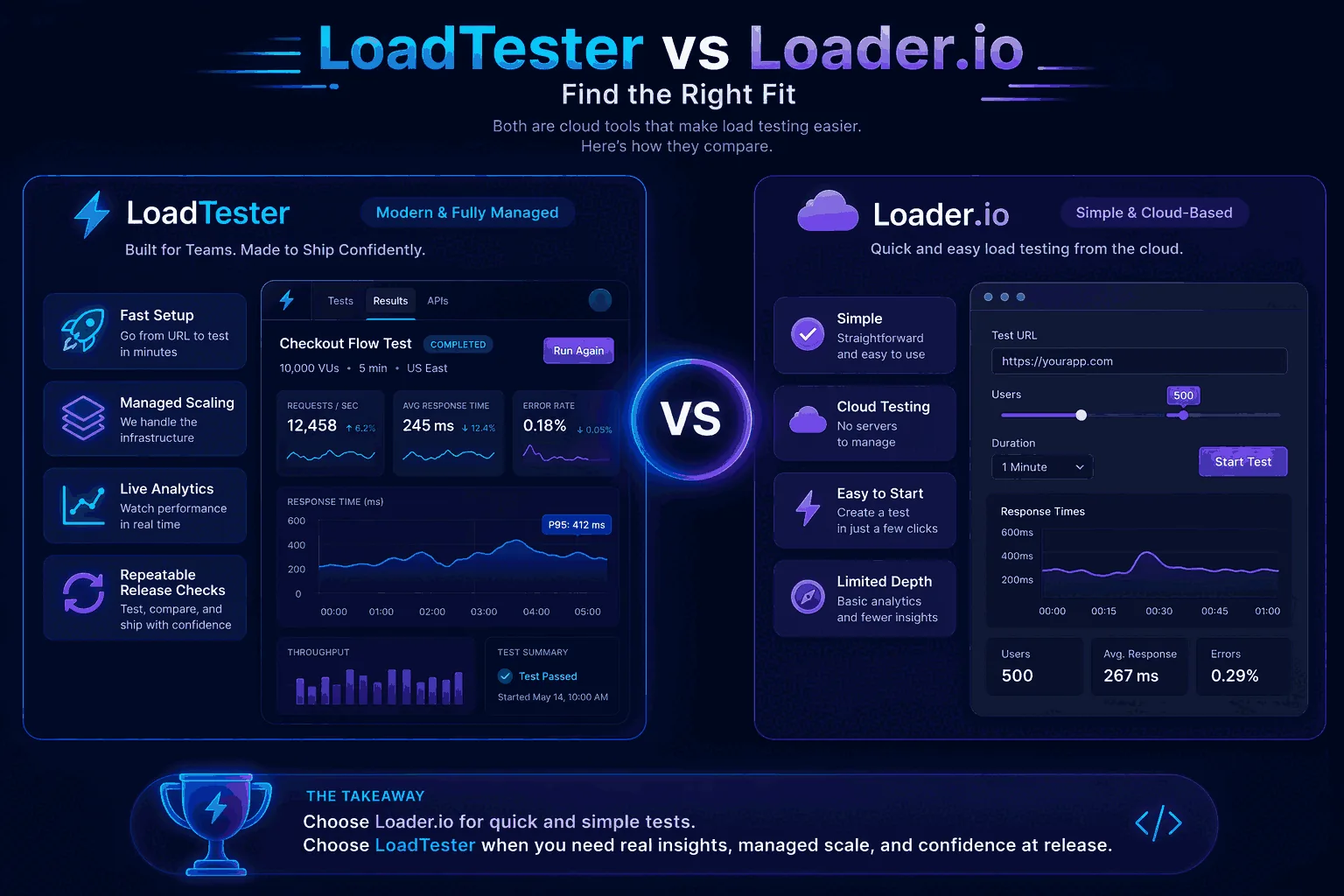
This page compares a quick hosted validation model with a broader release-quality workflow. Loader.io can answer a simple burst question; LoadTester is better when the same API checks must run repeatedly and produce reusable evidence.
At a glance
| Category | LoadTester.org | Loader.io |
|---|---|---|
| Best fit | Teams that want repeatable load testing built into real engineering workflows. | Teams that mainly want a simple first step. |
| Traffic control | Supports both exact RPS mode and VU mode. | Primarily known as a simpler traffic-generation tool. |
| Scenario depth | Multi-step scenarios, assertions, thresholds, and scheduled runs. | Better suited to lighter or more basic testing. |
| Automation | API tokens, GitHub Actions, GitLab CI, schedules, alerts, exports, and share links. | Less compelling once teams want a full workflow around repeated tests. |
| Collaboration | Public share links, annotations, compare runs, exports, and project/domain verification. | More limited as a shared workflow hub. |
| Long-term fit | Better once testing becomes part of release quality. | Often outgrown after the first stage. |
Why teams start searching for Loader.io alternatives
The search for Loader.io alternatives usually starts when the first-run experience stops being the main problem. Running one test is easy. The harder question is whether the tool still makes sense when you need tests every week, before releases, during launch windows, or as part of CI/CD. Once that becomes the standard, lightweight tooling often starts to feel narrow.
That is where LoadTester can be a better fit. The platform is built around repeated use. Instead of focusing only on the first successful test, it supports the whole cycle: configure a scenario, define checks, run it from the UI or automation, watch live metrics, stop on thresholds, share results, export reports, and compare runs later. That is a very different level of usefulness from a tool that mostly shines at getting you started.
Where LoadTester.org is clearly better than Loader.io
1. Exact traffic control with RPS mode and VU mode
LoadTester supports both exact RPS mode and VU mode. Some teams need a fixed requests-per-second target for API validation. Others want to model concurrent users moving through a route or flow. Having both options matters because real performance questions are not all the same. This makes LoadTester a stronger alternative to Loader.io for teams that need more than a basic one-dimensional traffic burst.
2. Multi-step scenarios instead of one-dimensional tests
Real traffic is not one request repeated forever. Users log in, fetch data, submit forms, hit webhooks, and move through different application states. LoadTester handles this much better with multi-step scenarios, so teams can validate flows that actually resemble production behavior.
3. Assertions, thresholds, and auto-stop
LoadTester supports assertions, failure thresholds, p95 thresholds, and auto-stop behavior. This turns a load test into a decision. The team can define what acceptable performance means before the test starts and immediately know whether the run passed or failed.
4. Workflow support that goes beyond a quick run
LoadTester supports API tokens, GitHub Actions, GitLab CI, schedules, Slack and email alerts, PDF/CSV/JSON exports, public share links, annotations, and compare runs. Those are the features that matter when load testing becomes a normal part of release quality instead of a one-off task.
Why workflow matters more than a first impression
Loader.io is easy to understand quickly. That is real. But the better question is whether a tool still feels right after the tenth test, the next launch, or the next production incident review. LoadTester is built around repeated use. The features work together in a way that supports real engineering habits: tokens, CI/CD, thresholds, assertions, schedules, alerts, compare runs, exports, share links, and project/domain verification.
That combination is why many visitors searching for the best Loader.io alternative end up preferring LoadTester. It does not just help them start. It helps them keep testing without friction.
Who should choose what
Loader.io is still fine for:
- Quick one-off checks
- Very simple endpoint tests
- Teams that just want a basic first step
LoadTester can be better for:
- Production systems
- CI/CD pipelines
- Scheduled recurring tests
- Scenario-based validation
- Teams that need collaboration and result sharing
- Organizations that want load testing to become part of normal release quality
If you are comparing different Loader.io alternatives, the simplest summary is this: Loader.io is easy to start with. LoadTester can be better to stay with.
Learn how to load test an API
If you are evaluating tools and also want the broader conceptual article, read What Is Load Testing? first. Then continue with How to Load Test an API for the practical tutorial. Together they cover definitions, traffic models, scenarios, thresholds, CI/CD workflows, and the mistakes teams make when performance testing is too shallow.
When Loader.io is the better choice
Loader.io is an older, simpler tool with a genuinely attractive free tier for its specific use case. It wins in a few concrete situations.
- You need a one-off check and nothing more. Spin up a test, get a graph, close the tab. Loader.io is optimised for that path and has almost no setup overhead.
- You are on a strict zero-budget constraint. Loader.io's free tier has historically been more forgiving than many modern alternatives' free tiers, particularly for duration. If free is a hard requirement and the limited features are acceptable, it is a reasonable pick.
- Your test is shallow by design. A single endpoint, a single method, no authentication, no multi-step flow. That is exactly the shape Loader.io was built for, and adding a more featured tool provides no benefit.
The fair limitation of Loader.io is that it is not really trying to solve the recurring-release-validation problem. If your team's need is a one-off or extremely shallow check, it can be the right tool; if the need grows into thresholds, scheduled baselines, run comparison, and CI/CD integration, you will outgrow it.
Questions teams still ask before choosing between tools
When can Loader.io still be enough?
It can still be enough for quick external checks and lightweight validation when the team does not need deeper scenario control, stronger workflow structure, or richer recurring reviews.
What breaks first as teams outgrow Loader.io?
Usually scenario depth, repeatability, governance, and the need to turn one-off tests into a workflow that survives handoffs and CI/CD adoption.
How should you validate a move away from Loader.io?
Recreate one meaningful test with auth, thresholds, and reporting, then see whether the new path is clearly easier to reuse and review under real team conditions.
These are the official docs, specs, or operational references most relevant to this topic.
How this comparison was evaluated
For the Loader.io comparison, we evaluated quick hosted validation against a broader API performance workflow. The review focused on ease of first run, scenario depth, assertions, scheduling, CI usage, reporting, history, and whether the test supports repeatable release decisions.
Loader.io can be the right answer for simple external URL checks. LoadTester is the stronger recommendation when the workflow needs to persist, integrate with delivery, and explain performance changes over time.
When Loader.io is enough
- You need a 30-second smoke test on a marketing site before launch, with no recurring requirement after.
- Your team has zero appetite for any tool with more than three input fields.
- You're checking a single static URL and don't need scenarios, thresholds, or comparisons.