
Rust-Based HTTP Load Testing Tools
If you search for Rust-based HTTP load testing tools, you are usually looking for three things: performance, low overhead, and a developer experience that feels more modern than older legacy utilities. That is why engineers often end up evaluating tools such as oha, other Rust-friendly CLIs, or even non-Rust tools that fit well in Rust-heavy environments.
Rust has become increasingly popular for network-facing systems because it offers memory safety and strong performance characteristics. It is natural that developers want Rust HTTP load testing tools that match those values. In practice, the landscape is mixed. Some useful tools are written in Rust, some are not but are popular among Rust teams, and some organizations build small internal harnesses with Rust libraries.
This guide explains what to look for in Rust-oriented HTTP load testing, compares several options, and explains when a team benefits from moving beyond CLI tools toward a managed platform like LoadTester. For a broader CLI overview, see Best CLI HTTP Load Testing Tools in 2026. For Linux-oriented usage, see Best HTTP Load Testing Tools for Linux.
Why Rust shows up in load testing discussions
Rust is attractive for systems tooling because it combines strong performance with memory safety. That makes it especially appealing for network tools, proxies, and observability agents. It also fits well with the kind of developers who care about predictable resource usage and correctness.
For load testing tools, that can translate into lower client-side overhead, faster execution, and a pleasant developer experience when the tool is designed well. It also fits naturally into Linux-heavy and containerized workflows where a single static binary is convenient.
But language choice is not the only thing that matters. A Rust-written tool is not automatically better at modeling traffic, integrating with CI/CD, or providing team-friendly analytics. That is why teams should evaluate not just implementation language but overall fit.
Quick verdict
Rust-based tools can be extremely efficient, but generator efficiency is not always the limiting factor. LoadTester is stronger when the missing pieces are saved tests, reports, thresholds, schedules, and organizational adoption.
Rust-oriented tools and workflows
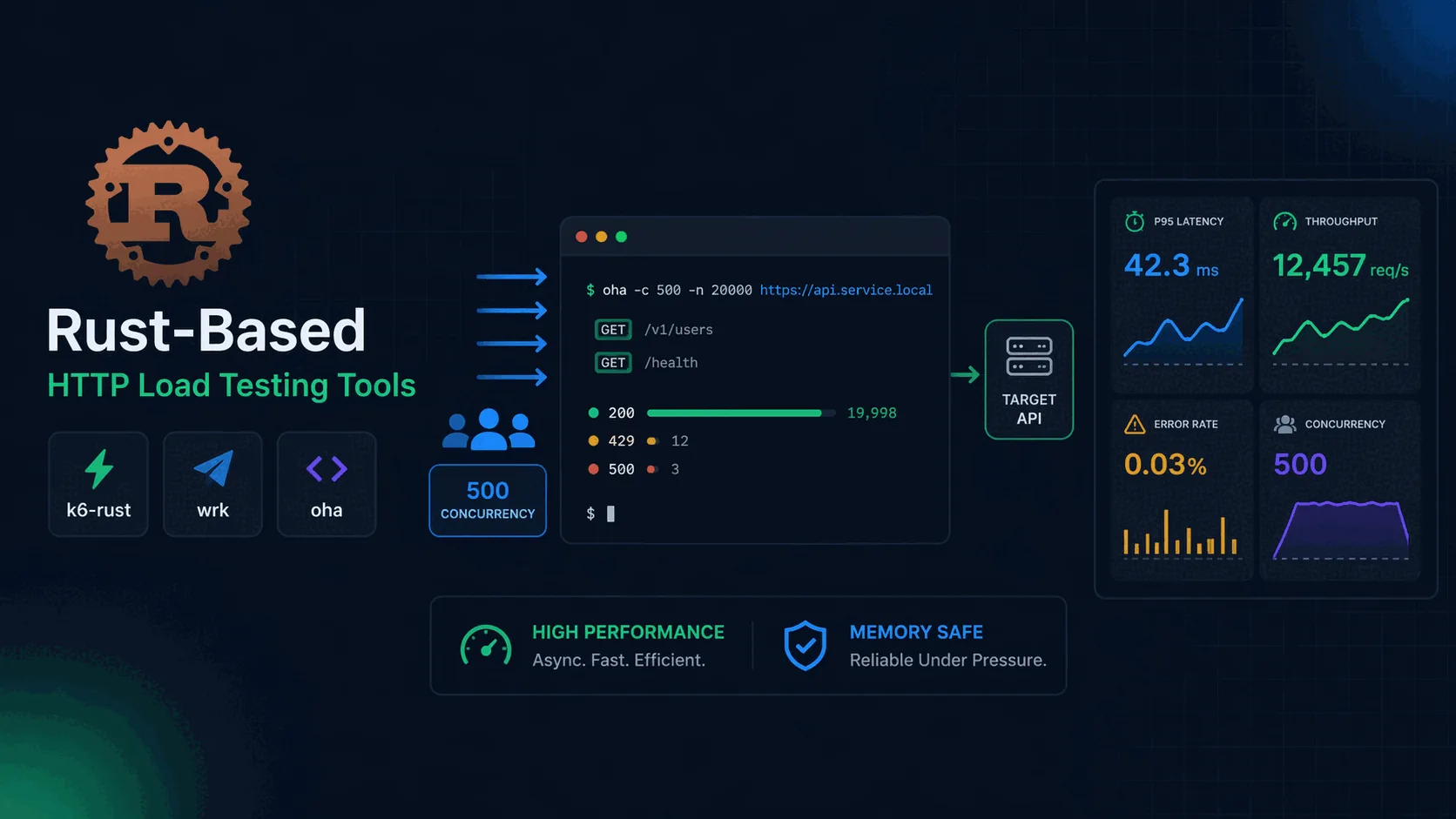
oha is one of the most visible Rust-based HTTP benchmarking tools. Its interface is clean and modern, and it is often compared with tools like hey and ApacheBench. It supports concurrency, duration, and request counts, and it produces readable summaries. For fast endpoint checks and CLI-first workflows, it is a strong option.
wrk is not written in Rust, but it still appears in Rust-heavy conversations because it remains one of the best-known high-performance HTTP benchmarking tools. It is fast, scriptable through Lua, and useful for straightforward stress tests. Teams using Rust services often pair them with wrk because they care about high throughput and low client overhead.
k6 is also not Rust-based, but some Rust-heavy teams prefer it when they want test-as-code workflows instead of a very small CLI. It offers a more structured scripting model and is often chosen when teams want to treat performance tests as part of the codebase.
Some organizations build internal Rust-based generators with libraries such as Hyper or Reqwest, but that is usually overkill unless the company has unique requirements or a dedicated performance engineering practice.
What to look for in a Rust-based HTTP load testing tool
First, look for low overhead and clear output. A load testing tool should not become the bottleneck. Rust-based tools often appeal because they are fast and efficient, but that only matters if the results are easy to interpret.
Second, look for reasonable traffic control. Can you define concurrency or request rates? Can you sustain traffic for a fixed duration? Can you add headers or bodies for API testing? Can you test against TLS or HTTP/2 if those matter?
Third, look for integration with your workflow. If your team uses Linux, containers, or CI, a single binary and simple scripting model can be a major advantage. But do not confuse “easy to run” with “easy to operate repeatedly.” If the team needs historical comparison, alerts, or shared dashboards, a CLI-only workflow may start to feel thin.
Finally, consider maintainability and team adoption. A fast tool is useful, but a performance practice depends on repeatability, documentation, and results that other people can understand.
CLI speed versus team workflow
Rust-based tools usually appeal most to engineers who want fast CLI workflows. That is entirely legitimate. There are many times when a quick command against a single API endpoint is exactly what you need.
The problem is that performance work rarely stays individual for long. Once releases depend on it, team members start asking questions such as: What happened compared with the last build? Are p95 latencies getting worse? Who owns the script? Where do we see failure trends? Is this traffic model representative of production?
Those questions expose the same limits found in other CLI tools. A Rust implementation may be fast and pleasant, but it does not automatically solve the workflow around the test of collaboration, baselines, and CI/CD history.
When Rust-based tools are a good fit
Rust-based tools are a good fit when you need fast, lightweight command-line testing and you value low overhead or the convenience of a single binary. They are particularly suitable for API endpoints, benchmarking during development, Linux-oriented environments, and teams that already live comfortably in the terminal.
They are also attractive when you want a simpler experience than JMeter or other heavier frameworks. Developers who build services in Rust often appreciate tools that feel consistent with the rest of their stack.
That said, they are best thought of as building blocks rather than full performance practices. The more your testing becomes part of CI/CD and release decisions, the more you need dashboards, thresholds, scheduled checks, and shareable results.
Where LoadTester fits
LoadTester does not try to replace every CLI tool. Instead, it addresses a different part of the problem: making application and HTTP load testing easier for teams. It lets you run tests without provisioning infrastructure, inspect live metrics, and compare runs over time.
That is especially useful when Rust-based services are part of a modern deployment pipeline and you want to know not just whether an endpoint survives today, but whether the system is regressing over time. Dashboards, alerts, and historical visibility are where managed workflows provide value that a raw CLI usually does not.
So the question is not “Rust tool or LoadTester?” It is usually “When is a fast Rust CLI enough, and when does the team need more?” In early development, a tool like oha may be perfect. For recurring release checks and easier collaboration, LoadTester often becomes the better fit.
Frequently asked questions
Does Rust actually generate more load than Go or C-based tools?
On a per-core basis, Rust tools like oha and drill are competitive with Go-based Vegeta and hey, and within striking distance of C-based wrk. The difference between any of these and a poorly-tuned Python or JVM-based generator is much larger than the differences between them. For most teams, the load generator is not the bottleneck — the network, the DUT, or the assertion logic is.
What does oha give you that Vegeta does not?
A real-time TUI dashboard during the run, which Vegeta does not provide. The metrics are similar, but oha is more pleasant for interactive exploration when you are tuning a service in front of you. Vegeta wins for scripted pipelines because of its structured JSON output, distributed attack mode, and longer track record. Pick oha for interactive use, Vegeta for automation.
Is it worth picking a load testing tool primarily for raw throughput?
Almost never. The constraint that ends up mattering is rarely 'how many requests can my generator emit'. It is 'can my team rerun this scenario in three months without help', or 'does this run produce a comparable result for the next build'. Tools optimized purely for throughput usually trade away the workflow features that matter when the same test has to live for a year.
These are the official docs, specs, or operational references most relevant to this topic.
How this comparison was evaluated
For the Rust tools page, we separated generator efficiency from team workflow. The evaluation considered local performance, installation, concurrency model, output format, CI use, result retention, comparison, and whether speed at the runner level actually solves the buyer’s problem.
Rust-based tools are often excellent for local benchmarking and developer ergonomics. LoadTester is the stronger choice when performance checks need shared context, historical evidence, and recurring execution.
When LoadTester is not the right option
LoadTester is intentionally focused on repeatable HTTP and API load testing workflows. For this page, the honest recommendation depends on whether your team needs Rust-based HTTP load testing tools for its native strengths or needs LoadTester for repeatable team execution.
- Use Rust CLIs for local efficiency. When low overhead and a single fast binary are the main requirements, a Rust-based tool may be the better fit.
- Use custom tooling for generator experiments. If you are studying client-side overhead, event loops, or request scheduling internals, a local tool is easier to inspect.
- Use self-hosted execution for private hosts. Restricted networks may require binaries that run exactly where the target is reachable.