
HTTP/2 Load Testing Tools: What to Use in 2026
HTTP/2 changes the shape of load testing. The moment you move from HTTP/1.1 assumptions into multiplexed streams, connection reuse, and different latency behavior under contention, older mental models start to break down. A tool that is fine for generic HTTP checks is not automatically the best tool for protocol-aware load testing.
That is why HTTP/2 load testing deserves its own guide instead of being buried inside a generic “best tools” roundup. Engineers searching for HTTP/2 tools are usually asking more specific questions. Does the client actually exercise HTTP/2 correctly? Can it help me reason about multiplexing and tail latency? Will it show me protocol-sensitive behavior before production traffic does?
This page covers the tools that matter most for HTTP/2 load testing in 2026: h2load, k6 in developer-first workflows, smaller HTTP tools where relevant, and LoadTester when the team wants protocol-aware checks inside a broader release-quality process. For general background, continue with What Is Load Testing?. For broader tool selection, use Best Load Testing Tools (2026).
Why HTTP/2 changes testing
In HTTP/1.1 thinking, teams often reason about concurrency in terms of more connections, more parallel requests, and progressively noisier contention. HTTP/2 complicates that by enabling multiple streams over the same connection and changing how head-of-line effects, prioritization, and reuse show up. That does not make HTTP/2 testing mysterious, but it does mean that naïve tools can hide meaningful behavior.
For example, the question is often no longer “how many requests per second can this endpoint do?” but “how does latency behave when many streams share the same connection and the service begins to saturate?” If your edge layer, gateway, CDN-facing service, or API transport strategy depends on HTTP/2 semantics, then a protocol-aware tool matters much more than raw request generation.
The main takeaway is simple: if HTTP/2 is an implementation detail, a generic load testing tool may be enough. If HTTP/2 is part of the operational question, choose tooling that makes that fact visible.
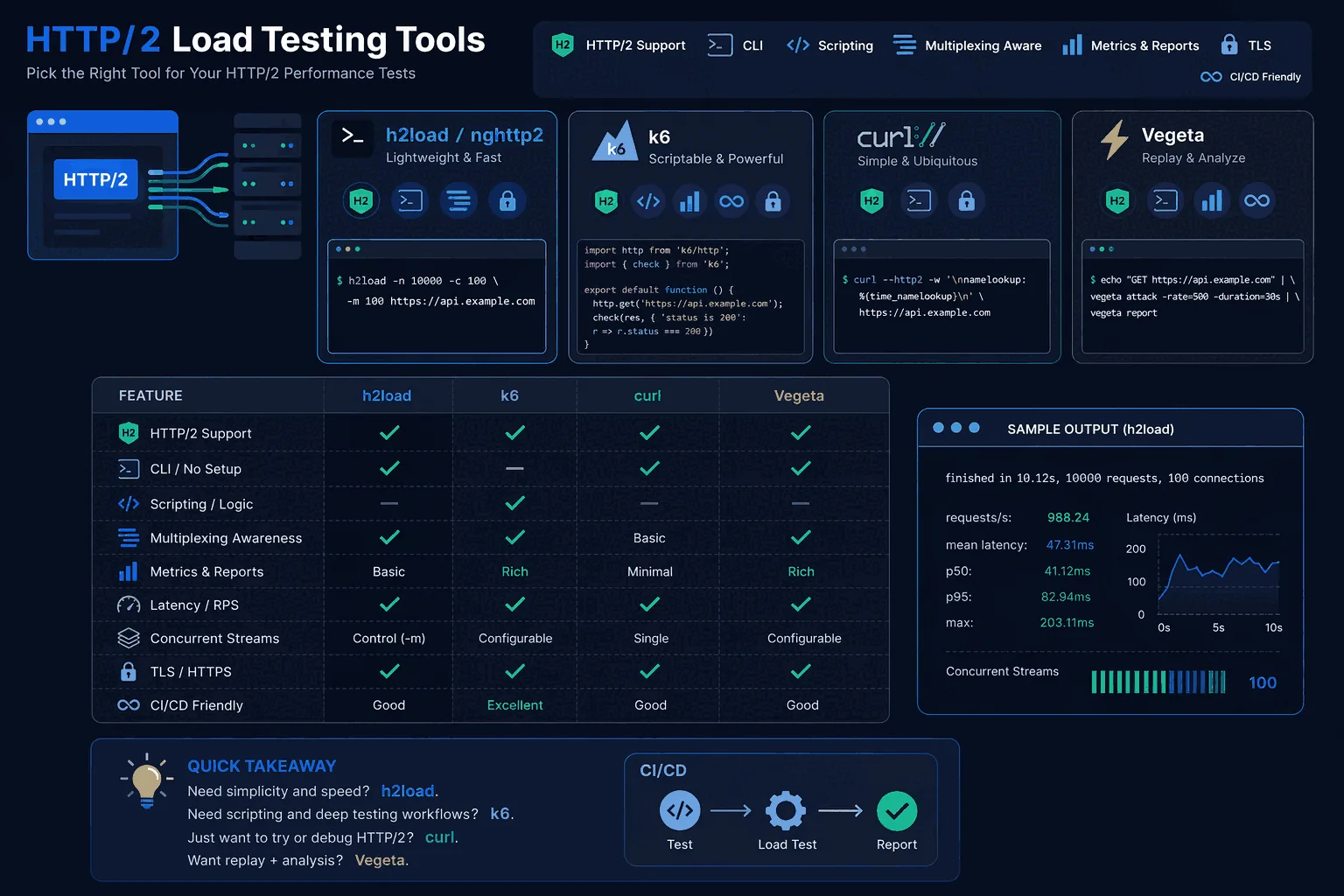
Quick verdict
HTTP/2 capability matters, but it is only one part of the decision. LoadTester is best when the team needs recurring API evidence over HTTP/2; specialist tools are better when the investigation is truly protocol-level.
What to measure in HTTP/2 load tests
The metrics are familiar, but their interpretation changes slightly. You still care about throughput, latency percentiles, and error rates. You still care about where performance bends or collapses. But for HTTP/2, you also care more about how multiple in-flight streams affect those outcomes. Averages are especially misleading here because multiplexing can hide painful tail behavior until traffic patterns become realistic.
Connection reuse is another area people often underestimate. A client that opens and tears down connections differently than real users can produce results that look busy but are operationally misleading. The same is true for upstream gateways or proxies that behave one way under light protocol usage and another under heavier stream concurrency.
In practice, good HTTP/2 testing means watching p95 and p99 latency closely, observing error patterns, and tying the protocol-level result back to a user-visible flow. It is easy to get hypnotized by the protocol and forget that the business question is still about stability and user experience.
h2load
h2load is the clearest first stop when your primary question is specifically about HTTP/2 behavior. It is part of the nghttp2 ecosystem and built for protocol-aware load generation rather than generic convenience. That focus is exactly why it deserves attention. For teams testing HTTP/2 semantics rather than just “some HTTP endpoint,” h2load is often the most honest tool in the room.
Its strength is specificity. You use it because the protocol matters and you want a client that reflects that concern. It is especially useful for infrastructure-heavy teams, platform engineers, and developers working close to gateways or transport behavior.
The trade-off is scope. h2load answers "is HTTP/2 multiplexing actually working under load?" better than any other tool on this list. It does not answer "is this release safe to ship?" — that requires the surrounding workflow (history, alerts, schedules, threshold gates) that protocol-specialist tools intentionally don't provide.
k6 for HTTP/2 scenarios
k6 remains relevant because many developer-led teams want protocol-aware testing inside a scripting model they can version and automate. If your team is comfortable maintaining tests as code and already works in a Grafana-heavy ecosystem, k6 can be a very strong way to operationalize HTTP/2-oriented checks. It lets teams move beyond one-off experiments and embed tests in broader engineering workflows.
The tradeoff is that with more flexibility comes more ownership. Teams that adopt k6 successfully usually want that. They are not looking for a minimal tool. They want tests in code, reviewable and repeatable. For some organizations, that is perfect. For others, especially those who want lower-friction adoption across a broader team, it can be more engineering surface than necessary.
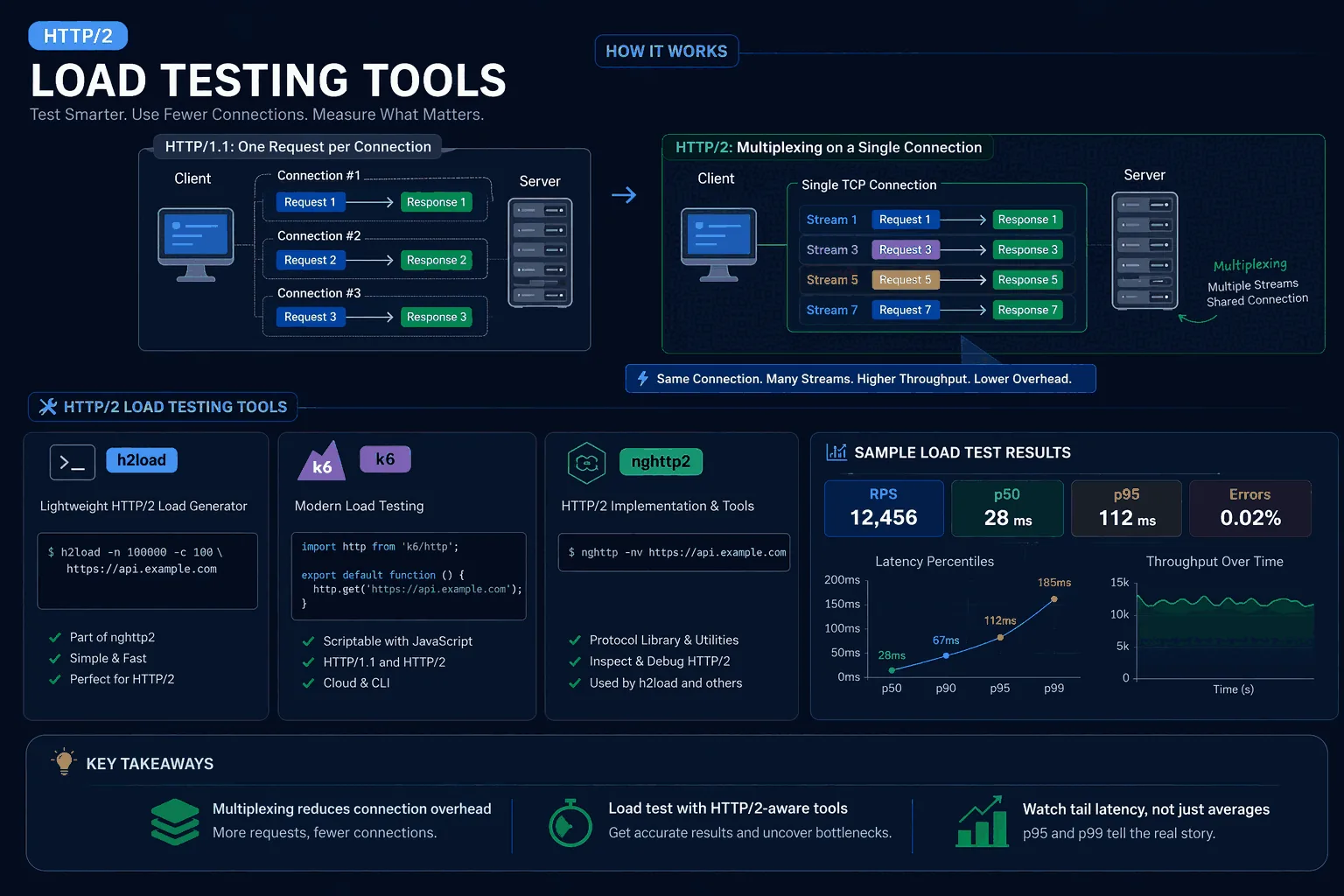
Vegeta and the HTTP/2 reality
Vegeta still comes up in HTTP/2 discussions because it is a respected HTTP load testing tool and many engineers already know it. It can absolutely be part of the conversation. But when the protocol is the core subject, tools built more explicitly around HTTP/2 usually make the signal easier to trust.
This is a common pattern in tool selection: a familiar tool can sometimes answer the question, but a more targeted tool can answer it more cleanly. That does not make Vegeta irrelevant. It means that when the test is explicitly about HTTP/2 behavior, h2load and strongly protocol-aware workflows deserve priority.
LoadTester for release-quality HTTP/2 checks
LoadTester becomes attractive when the question moves beyond “can I send HTTP/2 load?” to “can the team operationalize this as part of release quality?” That includes things like recurring checks before launches, clearer shared analytics, easier visibility into what changed between runs, and less operational burden around execution.
For many product teams, that is the real problem. They do not just want a protocol test. They want a repeatable process that can include protocol-sensitive APIs, HTTP endpoints, and web-app backends without forcing everyone into a shell-first workflow.
Which tool fits which team
If you care primarily about HTTP/2 protocol behavior, start with h2load. If you want tests as code and strong developer automation, k6 is usually the next serious option. If the team mainly wants repeatable checks with shared visibility and simpler operations, LoadTester is often the more practical answer.
That is the pattern across most performance tooling decisions in 2026. Start with the question, not the brand. If the question is protocol depth, choose the most protocol-aware tool. If the question is organizational repeatability, choose the tool that supports repeatability best.
Frequently asked questions
Why do most CLI load testing tools not properly test HTTP/2?
Most general-purpose CLI tools either default to HTTP/1.1 or open a fresh HTTP/2 connection for every request, which defeats the entire point of multiplexing. Real HTTP/2 traffic reuses long-lived connections and runs many concurrent streams over each one. If a tool reports HTTP/2 support but does not let you control connections-per-target and streams-per-connection, the numbers do not reflect production behavior.
Is h2load the right tool for HTTP/2 load testing?
h2load (from the nghttp2 project) is the most accurate HTTP/2 load generator because it was built around the protocol, not bolted on. It exposes connections, streams per connection, and HPACK header table size as first-class flags. The tradeoff is that h2load is a single-purpose CLI — no scenarios, no auth flows, no run history. Use it as the protocol-level reference, not as your release gate.
Should you load test HTTP/3 in 2026?
Yes, if your edge serves HTTP/3 to a meaningful share of users. HTTP/3 uses QUIC over UDP and behaves very differently from HTTP/2 under packet loss and connection migration. Tooling is thinner — h2load has experimental support, k6 added it more recently. If your CDN handles HTTP/3 termination and origins still speak HTTP/2 or HTTP/1.1, test the realistic origin-side protocol and rely on the CDN's own metrics for HTTP/3 client behavior.
These are the official docs, specs, or operational references most relevant to this topic.
How this comparison was evaluated
For the HTTP/2 tools page, we evaluated protocol capability and workflow separately. Criteria included connection reuse, multiplexing awareness, TLS and ALPN behavior, CLI versus managed execution, reporting, CI use, and whether the tool helps a team make a release decision.
Specialist HTTP/2 tools may be better for low-level protocol investigation. LoadTester is more appropriate when HTTP/2 is the transport behind recurring HTTP/API tests that need to be shared, scheduled, and compared.
When LoadTester is not the right option
LoadTester is intentionally focused on repeatable HTTP and API load testing workflows. For this page, the honest recommendation depends on whether your team needs HTTP/2 load testing tools for its native strengths or needs LoadTester for repeatable team execution.
- Use specialist tools for frame-level diagnosis. If you need to inspect protocol details, multiplexing edge cases, or server implementation behavior, a lower-level tool is better.
- Use local clients for network-path experiments. Testing from a specific host, region, or private network may require a local runner.
- Use code-first tools for complex connection logic. Custom connection management and transport experiments are often easier in code.