
Vegeta vs LoadTester: CLI vs managed comparison
Quick verdict
Vegeta is excellent for focused, rate-based HTTP work in the terminal. LoadTester is the better fit when those checks need to become ongoing team decisions with saved configuration, result history, and CI or scheduled execution.
Why teams start with Vegeta
They start there because Vegeta keeps the barrier low. A targets file, a command, a rate, a duration, and you have useful output. Engineers like tools that respect focus. Vegeta does. It is strong when the goal is direct HTTP pressure testing without dragging in a bigger platform. It also works nicely for teams that already live in shell automation and value small, composable tools.
Another reason teams start with Vegeta is that it teaches good habits better than some older utilities do. Its rate-based model encourages more deliberate thinking than a simple “fire N concurrent requests” mindset. That makes it a genuinely good tool for learning how to run controlled HTTP tests.
Where Vegeta shines
Vegeta is strongest when the owner of the test is also the person interpreting the result. That usually means a developer, platform engineer, or performance-minded backend lead working on a specific service question. It is also strong when tests are short-lived, narrow in scope, and unlikely to require collaboration outside the immediate owner.
Typical examples include validating a new endpoint, comparing the effect of a reverse proxy change, checking whether a header or auth pattern affects throughput, or doing quick pressure tests on internal services. In those situations, the speed of CLI invocation is a feature, not a limitation.
Vegeta is also attractive when the team already has strong observability and only needs the load generator. If metrics, dashboards, and release logic already live elsewhere, then the lightness of Vegeta becomes even more attractive.
Where friction starts
Problems start when the question is no longer “can I run a load test?” and becomes “can the team run the right test repeatedly, compare the result, and trust it as part of release quality?” That is where small tools often become workflow anchors without meaning to.
You see it when scripts drift across branches, thresholds are remembered instead of captured, output is pasted into chats, and every release raises the same question — “what did we run last time?” You also see it when one engineer becomes the human adapter for the testing system. The tool itself may be fine, but the surrounding workflow is not scaling with the team.
This is the point where people sometimes say, “Vegeta is powerful, but we still do not have a real performance testing process.” That sentence usually means they are no longer evaluating only the generator. They are evaluating ownership, repeatability, visibility, and operational overhead.
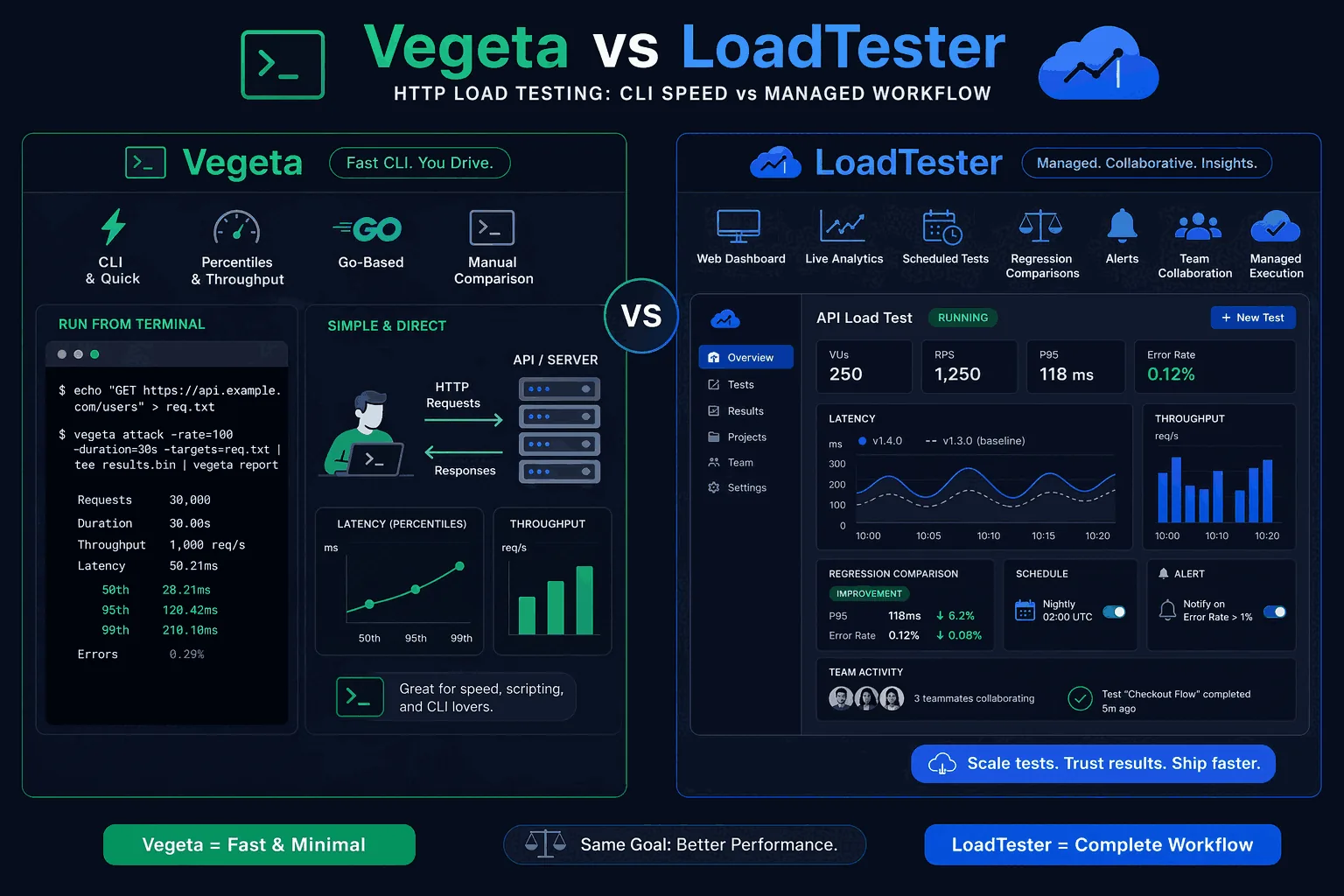
Vegeta vs LoadTester
The simplest comparison is this. Vegeta is a sharp tool. LoadTester is a workflow platform.
Vegeta gives you command-line control, rate-based testing, and a very efficient way to generate HTTP load. LoadTester gives you managed scaling, live analytics, dashboards, exports, scheduling, API automation, and a workflow that is meant to be reused across releases and team members.
That difference shows up immediately in adoption patterns. A team using Vegeta successfully usually has a technically confident owner who does not mind maintaining the shell logic around it. A team using LoadTester successfully often has a broader set of participants: developers, engineering managers, QA, or DevOps people who want clear results and less infrastructure setup.
Neither model is wrong. The wrong move is using one while expecting the benefits of the other. If you want CLI sharpness, Vegeta delivers that better than many alternatives. If you want team-facing release confidence with less glue work, LoadTester is the better fit.
CI/CD and release checks
Both tools can participate in CI/CD, but the ergonomics are different. Vegeta fits well when the team is happy to write and maintain the surrounding pipeline logic itself. That includes targets management, thresholds, result parsing, storage, and team-readable output. For some organizations, that is not a problem. They prefer owning the code and the behavior directly.
LoadTester fits better when the team wants the pipeline to trigger a known test and get a result that is already packaged for broader consumption. That is especially useful when release checks are recurring and need to be understandable by more than the person who wrote the original script.
If your CI/CD conversation is mostly about “how do we keep this simple and team-friendly,” managed tooling often wins. If it is mostly about “how do we express this exactly in code,” Vegeta may still be enough.
Reporting and team visibility
This is often the decisive category. Vegeta can produce useful output, and skilled engineers can absolutely build strong reporting around it. But that is the key phrase: build around it. Out of the box, CLI tools tend to assume that the person running the test knows how to interpret the result and where to put it next.
LoadTester changes the default. The platform is designed to make result sharing, live observation, comparison across runs, and broader visibility easier without building that layer yourself. Why this matters in real teams because reporting is often where performance practices either mature or stall.
If your current process involves screenshots, terminal output, or ad hoc notes after each test, you are already paying a workflow tax. LoadTester is more attractive the more that tax starts to annoy the team.
Cost and ownership
CLI tools often look cheaper because the binary itself is free or lightweight. But the real cost question is not just licensing. It is ownership. Who maintains the test definitions? Who updates them? Who explains the output? Who sets thresholds? Who keeps the process alive after a quarter of releases and staffing changes?
For some teams, owning that internally is absolutely fine. They have the engineering appetite and prefer to keep the stack close to code. For other teams, the hidden labor outweighs the appeal of the small tool. That is when a paid managed platform becomes cheaper in practice because it removes recurring coordination work.
This is one reason product teams often migrate from smaller tools to managed ones. They are not buying load generation. They are buying less workflow friction.
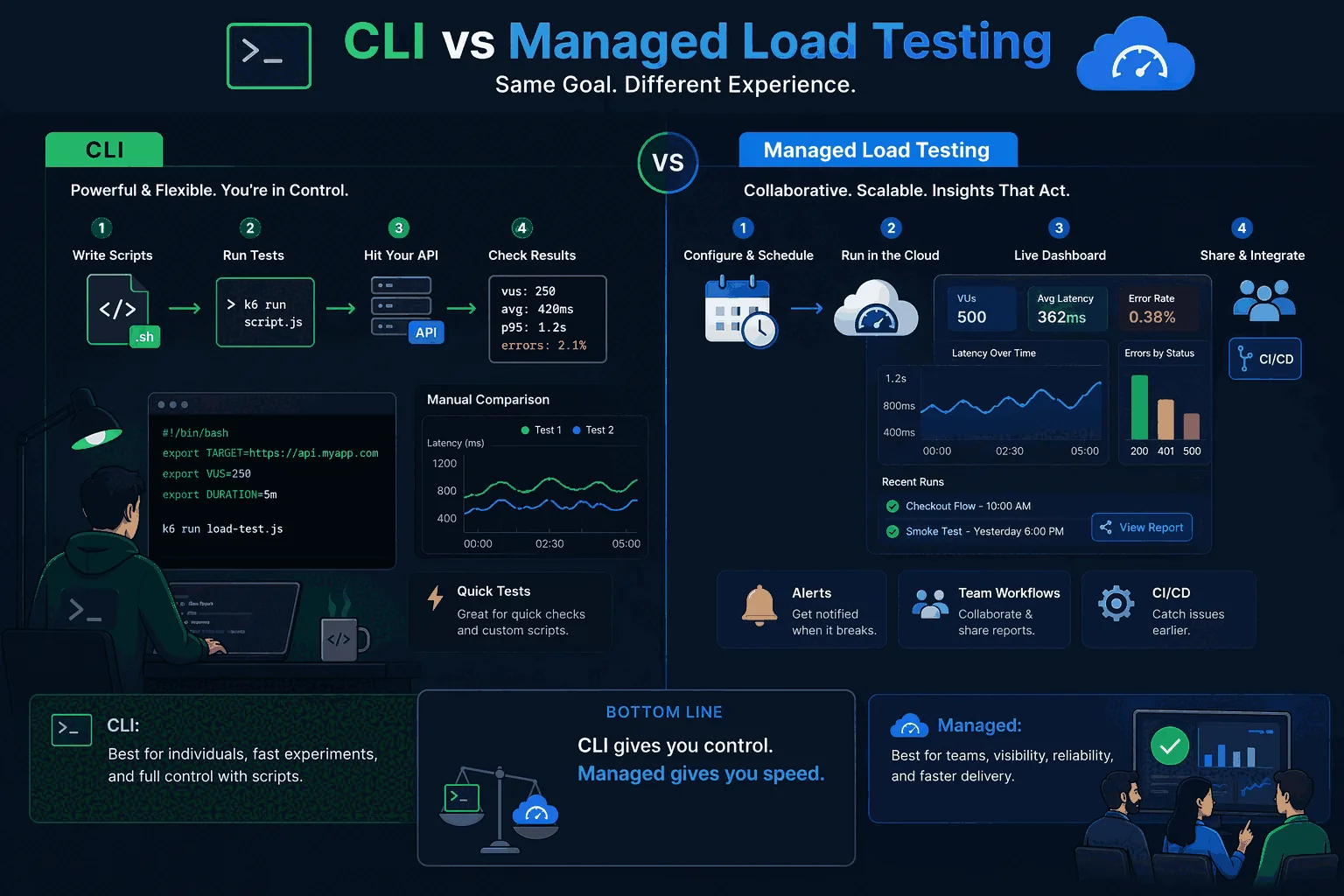
Who should choose which
Choose Vegeta if your team wants fast engineer-owned HTTP testing, is comfortable with shell-driven automation, and does not mind owning the lifecycle around scripts and results. It is especially good for backend-heavy teams asking narrow, precise questions.
Choose LoadTester if your team wants repeatable release checks, live visibility, easier handoff, managed execution, and a lower-friction way to make performance validation part of normal delivery. It is especially strong for SaaS teams, agencies, engineering managers, and mixed technical teams that care about adoption as much as raw control.
Another useful way to frame it: Vegeta is great when one person is driving. LoadTester can be better when the workflow needs to survive the team.
When Vegeta is the better choice
Vegeta is a focused, well-built command-line tool. For its intended shape of work, it is excellent.
- You want a tiny binary, scriptable, composable. Vegeta is a single Go binary that pipes attack specs in and results out. That composability is genuinely hard to beat for ad hoc engineering exploration.
- Your workflow is shell-first. If you're already comfortable chaining
vegeta attackthroughvegeta reportandvegeta plot, and your teammates are too, that workflow is fast and self-contained. - You need exact attack-rate control and nothing else. Vegeta models traffic as a constant rate of requests per second. For "send exactly N RPS and show me the distribution" there is very little overhead.
- You're building a local or CI smoke check with no reporting requirement. For a fail-fast check that produces a text result, Vegeta is a sensible choice.
Where it stops being the right answer: shared dashboards, multi-step scenarios, saved test definitions your whole team can rerun, scheduled baselines, regression comparisons, threshold-based auto-stop, and reporting for non-engineers. Those are out of Vegeta's scope by design. It is a CLI utility, not a platform — that's a feature, not a bug, until it isn't.
Questions teams still ask before choosing between tools
When should Vegeta still win?
Pick Vegeta when a CLI-first workflow is the explicit goal, the team is comfortable composing surrounding tooling, and fast scriptable runs matter more than broader team adoption.
What do teams underestimate when moving from Vegeta?
They often underestimate the effort needed to make a CLI-centric workflow readable, shareable, and sustainable for people who did not build it.
What is the safest way to compare Vegeta and LoadTester?
Run the same authenticated scenario with the same thresholds and evaluate not just performance output, but how quickly the team can rerun, review, and act on the result.
These are the official docs, specs, or operational references most relevant to this topic.
How this comparison was evaluated
For the Vegeta comparison, we evaluated Vegeta as a focused rate-based CLI and LoadTester as a managed HTTP/API workflow. The criteria included target definition, rate control, local reproducibility, output handling, CI fit, historical comparison, and team access.
Vegeta remains an excellent tool for engineers who want a small and composable binary. LoadTester is the better fit when the result must become a shared release decision rather than a local benchmark artifact.
When Vegeta is the better answer
- One-off rate-limit checks from a developer's laptop, where the result is for the engineer running it and nobody else.
- Embedding HTTP load generation in a Go binary or library — Vegeta has a clean Go API for that.
- Scripted, composable shell pipelines where stdin/stdout matters more than a result page.