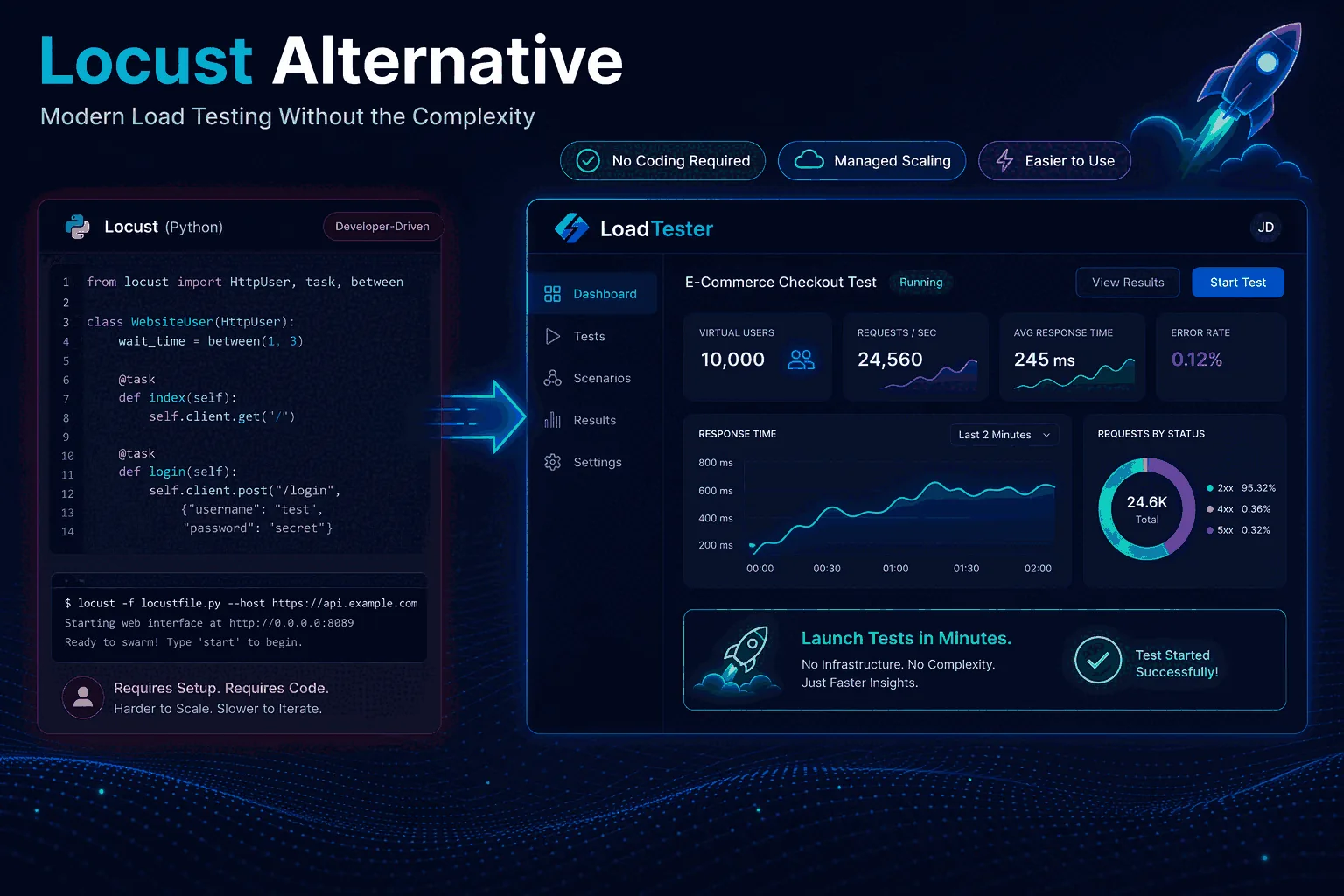
Locust Alternative
People usually search for a Locust alternative when they have already made one important decision: they are willing to use a code-driven tool for load testing. Locust is popular because it feels simple, flexible, and familiar to Python-heavy teams. That makes it easy to underestimate the second half of the equation, which is the actual operational cost of turning scripts into a repeatable performance testing practice.
Locust can absolutely be the right fit. If your team is comfortable in Python, likes writing scenarios in code, and is willing to own the surrounding workflow, it offers a straightforward way to model user behavior and generate load. But many teams find that once the first few tests are written, the real work begins. Tests need to be maintained, versioned, parameterized, integrated into CI/CD, interpreted consistently, and updated as the product changes. This is where “Locust alternative” searches usually begin.
This guide explains when Locust is a good fit, why teams start looking for alternatives, and which options are worth evaluating. We will focus on practical trade-offs rather than checklist marketing. If you are new to the fundamentals, begin with What Is Load Testing?. If you are selecting a workflow for recurring use, combine this article with Load Testing Strategy, How to Load Test an API, and Load Testing in CI/CD.
Why teams like Locust in the first place
Locust appeals to teams because it feels understandable. You define user behavior in Python, run the test, and scale it as needed. For organizations that already use Python for backend work, data processing, automation, or QA tooling, the language fit lowers resistance. That matters because the fastest way to kill a performance testing initiative is to make the authoring model feel foreign.
Another reason teams like Locust is that it encourages a readable, script-based workflow rather than a giant GUI artifact. That makes version control easier than older visual test-plan models and lets engineering teams treat load tests as real project assets.
Locust also benefits from a reputation for flexibility. If your team wants to shape custom traffic patterns, build special logic, or integrate with surrounding Python tooling, it can be a comfortable environment.
All of that is real. The problem is that the same strengths can hide the broader cost. A Python script is only one layer of a complete load testing workflow. Teams often realize later that they did not really choose “simple Python load testing.” They chose “owning the entire lifecycle in Python.”
Why people start searching for a Locust alternative
The first pain point is usually maintenance. At the beginning, writing one or two scripts feels lightweight. After a few months, you may have authentication helpers, environment switches, data generation logic, threshold checks, distributed execution patterns, and reporting conventions spread across multiple files or repositories. The load testing suite starts to behave like a small internal product.
The second pain point is accessibility. A Python-based workflow is accessible to Python-friendly engineers, but it is not automatically accessible to everyone else. Product managers, QA analysts, release managers, and even some developers may struggle to understand what the test is doing or how to update it safely. When only a narrow slice of the team can work with the suite, adoption usually stalls.
The third pain point is CI/CD maturity. Running scripts in automation is possible, but the hard part is deciding which tests belong where, how to set thresholds, how to compare results, and how to surface failures clearly enough that teams trust them. If your workflow still depends on manual interpretation, you do not have continuous performance testing yet.
The fourth pain point is time to answer. Most teams do not need more flexibility. They need faster, clearer answers to practical questions. Can the API handle the release? Did the last change harm p99 latency? Can the checkout path handle the campaign spike? If the route from question to result remains too manual, an alternative becomes attractive.
What a better alternative should improve
A good Locust alternative should reduce friction in areas that matter operationally.
It should lower the cost of authoring and maintenance. That does not necessarily mean “zero code.” It means the team should spend less time fighting the mechanics of the test and more time designing realistic scenarios and interpreting results.
It should improve team usability. More than one person should be able to understand, review, and trust the load testing workflow. That is especially important if you want performance testing to become a normal release habit.
It should fit CI/CD cleanly. The best alternatives make it straightforward to create small checks for pull requests, medium baselines for staging, and larger recurring tests for critical systems. If your process still treats load testing as a one-off event, the tool is not solving the whole problem.
It should make results easier to act on. Metrics should help the team reason about bottlenecks, throughput, and tail latency, not just admire request counts. Read p95 vs p99 latency explained if your team still leans too heavily on averages.
When Locust is still the right tool
Before chasing alternatives, it is worth stating clearly that Locust can be a very good choice in the right environment.
If your team is strongly Python-centric, already comfortable writing maintainable scenario code, and willing to own the surrounding execution and analysis workflow, Locust may be entirely sufficient. It can also be a strong fit when your use case demands custom behavior and you want to shape the testing logic directly.
If the suite is small, the service boundaries are clear, and the same engineers who build the APIs also own the performance tests, the operational burden may stay reasonable for quite a while.
And if your main issue is not the tool but your lack of realistic traffic models or thresholds, switching platforms will not fix the deeper problem. In that case, go read Load Testing Strategy and How to Load Test an API before changing tools.
Still, many teams discover that what looked like a flexible advantage becomes a maintenance tax as the organization grows.
Alternative 1: k6
k6 is one of the most natural alternatives to Locust because it preserves the code-first philosophy while changing the scripting model and overall developer experience. Instead of Python, you work in JavaScript. For many product engineering teams, that is a positive because JavaScript is familiar and the CLI-driven workflow feels modern and clean.
Compared with Locust, k6 often wins on developer ergonomics in teams that already embrace Git-based automation. Thresholds, scenario logic, and outputs are easy to keep close to the application lifecycle. The model feels aligned with CI/CD from the start.
The downside is that it does not fundamentally remove the scripting burden. If your real goal is to stop owning so much of the testing lifecycle yourself, moving from Locust to k6 may improve the experience without fully solving the underlying problem.
For teams that still want an open, code-driven workflow but prefer a different authoring model, k6 is a strong candidate. See Gatling vs k6 vs JMeter and LoadTester vs k6 for related context.
Alternative 2: Gatling
Gatling is less often chosen by teams moving away from Locust, but it can make sense when the team wants a stronger framework model and more emphasis on sophisticated scenario expression. It is a more engineering-heavy path rather than a simplification path.
If the main complaint about Locust is that the team wants more explicit performance-focused structure and does not mind adopting a specialized framework, Gatling can be worth evaluating. For many teams, however, it is a trade from one code-centric approach to another rather than a real reduction in operational cost.
That is why Gatling is usually a niche alternative from Locust rather than the first recommendation. It solves a different type of problem. If you are curious about the broader comparison, read Gatling Alternative and Gatling vs k6 vs JMeter.
Alternative 3: JMeter
JMeter often appears in searches because it offers a GUI approach instead of code-first authoring. If your team is frustrated by writing and maintaining Python scripts, a visual tool can sound attractive. And for some organizations, especially those with heavy QA involvement and lower coding comfort, JMeter may indeed reduce the initial barrier to entry.
But it is important not to confuse lower first-step friction with lower long-term friction. JMeter test plans can become large and difficult to maintain. Complex variable handling, authentication flows, and test-plan reuse can become awkward over time. Many teams that leave code-based tools for GUI-based workflows eventually encounter a different maintenance problem rather than escaping maintenance entirely.
JMeter is best considered when your real pain with Locust is authoring style, not when your pain is the overall cost of running a mature load testing practice.
Alternative 4: LoadTester
For many teams, the best Locust alternative is not another framework or scripting language. It is a more direct path from idea to useful result.
LoadTester is attractive when your biggest pain is not the ability to write tests, but the amount of work required to keep load testing repeatable and operationally lightweight. Instead of managing a growing set of Python scripts, helper libraries, execution environments, and reporting conventions, teams can focus on the parts that matter most: scenario design, thresholds, and release confidence.
This makes LoadTester especially compelling for product and platform teams that want regular API and website load testing without turning the practice into a mini internal engineering platform. It also tends to be easier to socialize across mixed teams because the workflow is not as dependent on one language or one small author group.
That is the key distinction. Locust is often attractive because it is simple to start. LoadTester becomes attractive because it is simpler to sustain.
Open source alternative or workflow alternative?
This distinction matters just as much here as it does in any other tool comparison.
If you move from Locust to another open source tool like k6, you are mostly changing the authoring and execution model. That can absolutely improve your day-to-day experience. But you still own the broader practice.
If you move from Locust to a managed platform, you are changing more of the workflow itself. That can reduce the burden of orchestration, reporting, and repeatable execution enough that performance testing becomes routine rather than sporadic.
Neither option is automatically better. It depends on your team’s goals. If you value full control and enjoy code-based ownership, another open tool may be best. If you value speed, consistency, and broader team adoption, a managed option may create more leverage.
Locust alternatives by use case
For API-heavy teams, the main requirement is usually fast authoring, clear thresholds, and pipeline integration. k6 is often attractive here, and managed platforms can be even more practical when the team wants less scripting overhead. Pair this with How to Load Test an API.
For website testing, the situation gets more nuanced because not every website performance question should be answered by protocol-level load generation alone. You often need layered thinking: backend load testing, edge behavior, and frontend UX analysis. Read Website Load Testing vs API Load Testing to avoid mixing concerns.
For GraphQL APIs, you need to think carefully about query shape, resolver cost, complexity, and caching. A generic “send more requests” workflow is not enough. See GraphQL Load Testing for the deeper discussion.
For CI/CD-driven teams, prioritize alternatives that make small, repeatable checks easy to run on every change. If load testing only happens before major releases, the workflow is still too heavy. Read Load Testing in CI/CD.
How to evaluate alternatives without wasting time
The best way to evaluate a Locust alternative is to test a real scenario end to end.
Take one important workload, such as:
- authentication plus one critical API flow
- a search endpoint with filtering and pagination
- webhook ingestion under burst traffic
- checkout with session handling
- a GraphQL query mix across hot and cold data paths
Then compare tools on these steps:
- Build the scenario
- Parameterize realistic data
- Define thresholds
- Run locally
- Run in CI or staging automation
- Share the results with the team
- Update the scenario after a product change
This reveals the practical cost far better than a feature matrix. You will learn how quickly the team can move, how readable the tests are, and how easy it is to turn raw metrics into a release decision.
Migration plan: moving off Locust safely
If you decide to move away from Locust, migrate with intent.
Start with your highest-value test cases, not the largest scripts. These are the scenarios that directly protect releases or critical services. Move those first so the new workflow proves its value quickly.
Document your current thresholds before you migrate. A script without explicit performance expectations is not really a decision-making tool. Convert those expectations into concrete thresholds around error rate, p95 latency, p99 latency, and throughput.
Avoid carrying every old abstraction into the new tool. Migration is the perfect moment to simplify. Remove clever test logic that does not materially improve realism or decision quality.
Finally, make the new tests part of the development lifecycle. That means scheduled runs, build-stage checks, or release-gating baselines, not just a one-time port. The goal is not “we have switched tools.” The goal is “performance testing now happens reliably.”
Common reasons teams regret staying too long
Some teams know the workflow is getting heavier but keep postponing change because the existing suite still works. That is understandable, but there are common warning signs.
One is that adding a new scenario feels like project work rather than routine testing work.
Another is that result interpretation is inconsistent, with each author formatting or explaining outputs differently.
A third is that the suite is rarely touched between major incidents or launches, which means the operational burden has already become too high.
A fourth is that the testing practice is narrower than the system risk. For example, the team may have one or two Locust scripts for APIs but no repeatable workflow for CI/CD regression checks, website traffic spikes, or GraphQL query mixes.
If these patterns are visible, the case for evaluating alternatives is strong.
Which Locust alternative is best for most teams?
If you want another code-first tool with a modern developer feel, k6 is usually the most natural alternative.
If you specifically want a stronger performance framework and are willing to increase specialization, Gatling may be worth a look, though it is not usually the simplest path.
If you want to escape scripting overhead and make recurring load testing easier for a broader team, LoadTester is usually the best overall alternative.
That last point matters because many teams searching for a “Locust alternative” are not actually dissatisfied with Python. They are dissatisfied with how much ongoing ownership the entire workflow requires.
Final thoughts
Locust is popular for good reasons. It is approachable for Python teams, flexible, and script-driven in a way that fits many engineering environments. But its real cost is not visible in the first script. It appears over time, as scenarios multiply, thresholds evolve, and the organization needs performance testing to become repeatable.
The best alternative depends on what you are trying to improve. If you want a different code-first experience, k6 is the usual front-runner. If you want less friction across the whole practice, a managed platform like LoadTester is often the stronger move.
Choose the option that makes performance work easier to maintain, easier to automate, and easier to trust across the team.
FAQ
What is the best alternative to Locust?
For many developer-led teams, k6 is the strongest open source alternative because it offers a modern scripting and CI/CD workflow. For teams that want less maintenance and broader usability, LoadTester is often the best overall alternative.
Is Locust better than k6?
That depends on the team. Locust is attractive for Python-heavy organizations. k6 is often preferred by teams that want a modern JavaScript-based workflow and cleaner CI/CD ergonomics. Neither is universally better.
Why do teams move away from Locust?
Common reasons include growing maintenance burden, limited team accessibility, inconsistent reporting, and the challenge of turning scripts into a repeatable end-to-end performance testing practice.
Is JMeter a good alternative to Locust?
It can be for teams that want a GUI instead of code. But it can also introduce its own long-term maintenance challenges, so it is not always the best modernization path.
Should I switch from Locust to a managed tool?
You should consider it if your biggest pain is not Python itself but the total operational effort required to keep load testing useful, repeatable, and visible to the whole team.
Locust vs managed platforms: the real trade-off
Teams often compare Locust to other open source tools and still miss the most important distinction: who owns the workflow after the script exists.
With Locust, your team usually owns the Python code, execution model, thresholding conventions, report formatting, environment handling, and a fair amount of the “how do we run this regularly?” question. That is not a flaw. It is just the reality of a code-first tool.
Managed platforms reduce more of that operational surface area. Instead of asking only “can we describe the scenario,” they ask “can we get a trustworthy answer quickly, and can more than one person on the team use the workflow comfortably?” That is why managed alternatives are often more appealing to product teams than pure framework-to-framework swaps.
This difference becomes especially important once you start layering your tests. Tiny checks in pull requests, baseline runs in staging, and larger scheduled tests in production-like environments are easy to describe in theory. They are harder to maintain in practice unless the surrounding workflow is streamlined.
Questions to answer before you replace Locust
Do not switch just because another tool is fashionable. Replace Locust only when the next workflow solves a specific constraint you already feel. For most teams, that constraint is not raw request generation. It is the operational shape around the tests.
- Who owns scenario updates when the API changes?
- How are results shared with people outside the original test author?
- Can the same workflow support quick smoke checks and larger scheduled runs?
- Are percentiles, thresholds, and baselines easy to compare over time?
- Does the tooling reduce friction for the whole team or only for the most script-comfortable engineer?
If your answers point toward collaboration, repeatability, and decision-ready reporting, you are not really shopping for another script engine. You are shopping for a better operating model around performance testing.
Quick recommendation by team type
If you are a small Python-first startup and do not mind owning the full workflow, stay with Locust or test k6 as the main open source alternative.
If you are a mixed engineering and QA team and want a lower-maintenance workflow, skip the language debate and evaluate a managed option directly.
If you are doing serious GraphQL or API performance testing and need fast repeatability across releases, focus less on raw flexibility and more on how easily the tool fits your delivery process.
If you are trying to make load testing visible to more of the company, choose the workflow that reduces specialization rather than adding more of it.
Use LoadTester when you need API and website load tests that are easy to share, repeat, compare, and wire into delivery without building extra performance tooling around them.